
Best Ethical Hacking Certifications for Beginners: Top Picks

Published:

Updated:

Best Ethical Hacking Certifications for Beginners

Disclaimer

As an affiliate, we may earn a commission from qualifying purchases. We get commissions for purchases made through links on this website from Amazon and other third parties.

Spread the love

The best ethical hacking certifications for beginners are Certified Ethical Hacker (CEH) and CompTIA Security+. Both certifications provide a solid foundation in cybersecurity.

Ethical hacking certifications are essential for aspiring cybersecurity professionals. They offer structured learning paths and validate your skills. The Certified Ethical Hacker (CEH) is renowned for its comprehensive coverage of hacking techniques. CompTIA Security+ is another excellent choice, focusing on broader security principles.

Both certifications are globally recognized and respected in the industry. They equip beginners with the necessary knowledge to tackle cybersecurity challenges. Investing in these certifications can boost your career prospects and open doors to various job opportunities. Start your journey in ethical hacking with these credible certifications and build a strong foundation in cybersecurity.

Introduction To Ethical Hacking

Ethical hacking involves finding and fixing security flaws. These flaws can harm systems and data. Ethical hackers use the same skills as malicious hackers. But they work to protect rather than harm. Learning ethical hacking can open many career doors.

Importance Of Certifications

Certifications show your skills and knowledge in ethical hacking. They prove you have learned essential concepts and tools. Employers trust certified professionals more. Certifications can boost your job prospects and salary.

Certification Provider Focus Area
Certified Ethical Hacker (CEH) EC-Council Penetration Testing
CompTIA Security+ CompTIA Basic Security Skills
Offensive Security Certified Professional (OSCP) Offensive Security Advanced Penetration Testing

Career Opportunities

Ethical hacking certifications can lead to various jobs. Here are some roles you can aim for:

  • Penetration Tester: You test systems for security flaws.
  • Security Analyst: You monitor and improve network security.
  • Security Consultant: You provide expert advice on security practices.

Many industries need ethical hackers. You can work in tech, finance, healthcare, and government. Ethical hackers help protect sensitive data and systems. This makes them valuable assets in any sector.

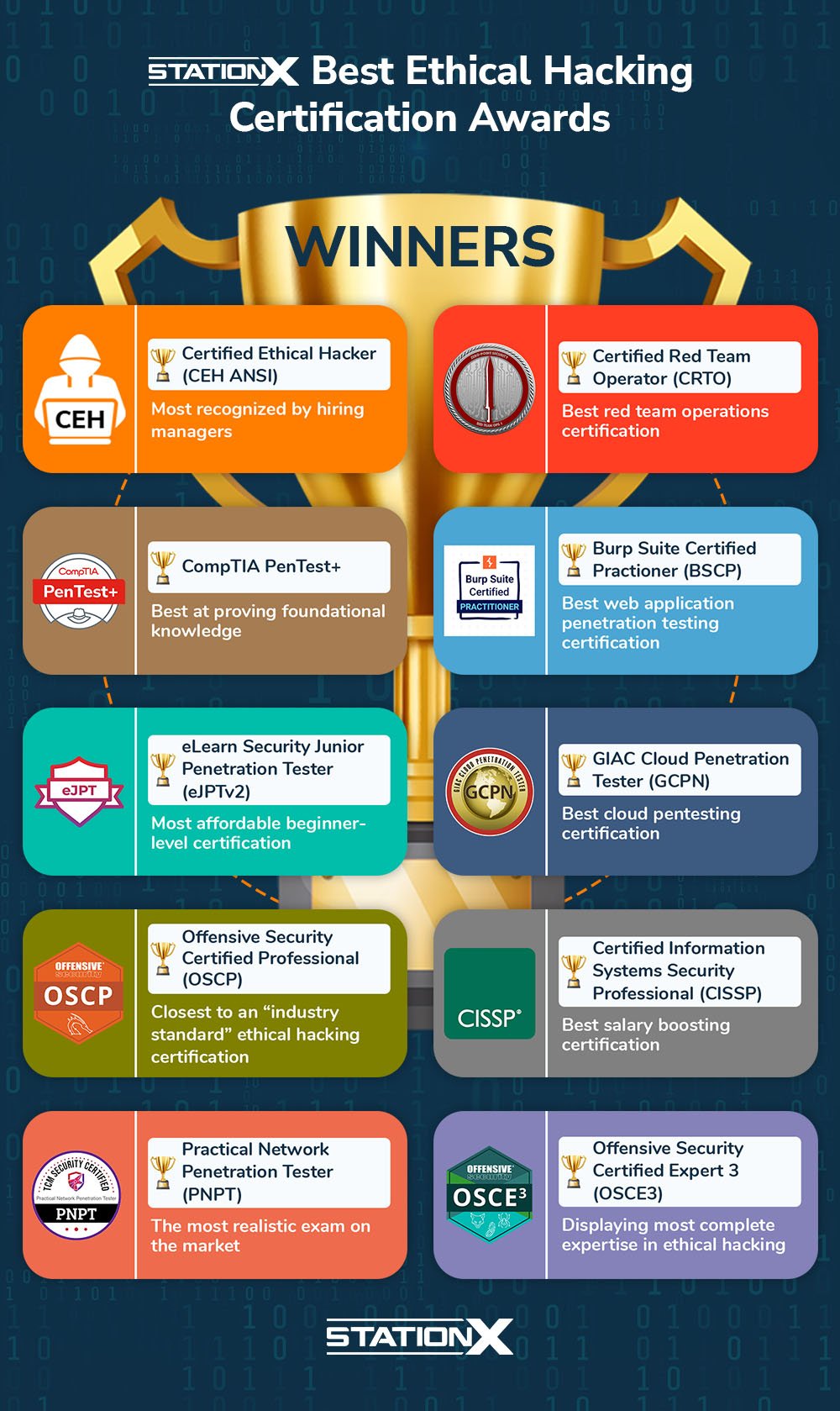
Best Ethical Hacking Certifications for Beginners: Top Picks

Credit: www.stationx.net

Certified Ethical Hacker (ceh)

The Certified Ethical Hacker (CEH) certification is a top choice for beginners. It helps you understand the mindset of a hacker. This certification teaches you to defend against cyber threats.

Overview

CEH is offered by the EC-Council. The course covers five phases of ethical hacking. These phases are:

  1. Reconnaissance
  2. Gaining Access
  3. Enumeration
  4. Maintaining Access
  5. Covering Tracks

The course includes hands-on labs and real-world scenarios. This makes learning practical and engaging.

Benefits For Beginners

CEH is ideal for those new to ethical hacking. Here are the key benefits:

Benefit Description
Comprehensive Knowledge Covers various hacking techniques and tools.
Practical Learning Hands-on labs help you practice real scenarios.
Industry Recognition CEH is recognized globally by employers.
Career Opportunities Opens doors to entry-level cybersecurity jobs.

CEH certification helps build a solid foundation in ethical hacking. It gives you the skills to protect systems and networks.

Comptia Security+

The CompTIA Security+ certification is a great entry point for aspiring ethical hackers. It covers essential security concepts and provides a solid foundation. Recognized globally, it validates your skills and knowledge in cybersecurity.

Course Content

The CompTIA Security+ course includes various topics crucial for beginners:

  • Network Security
  • Compliance and Operational Security
  • Threats and Vulnerabilities
  • Application, Data, and Host Security
  • Access Control and Identity Management
  • Cryptography

Each module offers practical insights and hands-on experience. The curriculum ensures you understand core security principles.

Industry Recognition

The CompTIA Security+ is well-regarded in the IT industry. Many employers seek candidates with this certification.

Feature Details
Global Recognition Accepted by organizations worldwide
Vendor-Neutral Applicable across various platforms and technologies
Government Endorsement Approved by the U.S. Department of Defense

Achieving the CompTIA Security+ certification can boost your career prospects. It demonstrates your commitment to cybersecurity and ethical hacking.

Best Ethical Hacking Certifications for Beginners: Top Picks

Credit: www.youtube.com

Offensive Security Certified Professional (oscp)

The Offensive Security Certified Professional (OSCP) is one of the top ethical hacking certifications. It is highly respected in the cybersecurity field. Beginners find it challenging but rewarding. The OSCP certification focuses on practical skills and hands-on experience. It is ideal for those who want to prove their hacking skills.

Training Methods

The OSCP certification offers various training methods to prepare candidates. The primary method is the Penetration Testing with Kali Linux (PWK) course. This course includes:

  • Video tutorials
  • PDF guides
  • Lab exercises

Candidates get access to a virtual lab environment. This lab contains real-world scenarios for practice. The training focuses on practical application rather than theory.

Skill Requirements

Before starting the OSCP, certain skill requirements are necessary. Candidates should have basic knowledge of:

  • Networking
  • Linux operating systems
  • Programming languages like Python or Bash

Understanding how to use Kali Linux is crucial. The OSCP exam is 24 hours long. It tests the candidate’s ability to hack into several systems. Candidates must document their findings and methods used.

Meeting these skill requirements ensures better preparation. It increases the chances of passing the OSCP exam.

Training Method Description
Video Tutorials Step-by-step guides on various hacking techniques.
PDF Guides Comprehensive written materials for deeper understanding.
Lab Exercises Hands-on practice in a virtual lab environment.

Giac Penetration Tester (gpen)

The GIAC Penetration Tester (GPEN) certification is a popular choice for beginners in ethical hacking. This certification validates your skills in penetration testing and vulnerability assessment. It is recognized globally and respected by employers.

Curriculum

The GPEN curriculum is comprehensive and covers many topics. Below is a breakdown of the key areas:

  • Penetration Testing Concepts: Learn the basics of ethical hacking.
  • Information Gathering: Techniques to collect data about targets.
  • Vulnerability Scanning: Identify and assess vulnerabilities.
  • Exploitation: Methods to exploit identified vulnerabilities.
  • Reporting: How to document findings and create detailed reports.

The GPEN certification also emphasizes hands-on experience. It includes practical labs and real-world scenarios. This ensures you can apply what you learn.

Job Market Value

GPEN certification is highly valued in the job market. It opens many opportunities in cybersecurity. Below is a table showing potential job roles and average salaries:

Job Role Average Salary
Penetration Tester $95,000
Security Consultant $105,000
Vulnerability Analyst $90,000

Many companies value the GPEN certification. It demonstrates your skills and knowledge in penetration testing. This makes you a strong candidate for cybersecurity roles.

Certified Information Systems Security Professional (cissp)

The Certified Information Systems Security Professional (CISSP) is one of the most respected certifications in the cybersecurity field. It is designed for professionals who want to advance their careers in information security. Earning a CISSP demonstrates a deep understanding of cybersecurity principles and best practices.

Prerequisites

To qualify for the CISSP exam, candidates must have at least five years of work experience in the information security field. This experience must be in two or more of the eight domains of the CISSP Common Body of Knowledge (CBK).

  • Security and Risk Management
  • Asset Security
  • Security Architecture and Engineering
  • Communication and Network Security
  • Identity and Access Management (IAM)
  • Security Assessment and Testing
  • Security Operations
  • Software Development Security

Candidates without the required experience can still take the exam and become an Associate of (ISC)². They then have six years to gain the necessary experience to earn the full CISSP certification.

Career Advancement

Holding a CISSP certification opens up many career opportunities. It is recognized globally and often a requirement for senior-level positions. Some of the roles that benefit from a CISSP include:

  1. Chief Information Security Officer (CISO)
  2. Security Consultant
  3. Security Analyst
  4. IT Director/Manager
  5. Security Systems Engineer

The CISSP also leads to higher salaries. According to industry surveys, CISSP-certified professionals earn significantly more than their non-certified counterparts.

Position Average Salary (USD)
Chief Information Security Officer (CISO) 150,000 – 250,000
Security Consultant 90,000 – 150,000
Security Analyst 70,000 – 120,000
IT Director/Manager 100,000 – 180,000
Security Systems Engineer 80,000 – 140,000

Obtaining a CISSP certification is a great way to advance in the cybersecurity field. It provides the skills and knowledge needed to protect information systems from cyber threats.

Ec-council Certified Security Analyst (ecsa)

The EC-Council Certified Security Analyst (ECSA) certification is a step up for budding ethical hackers. It builds on the basics learned in the CEH (Certified Ethical Hacker) course and dives deeper into advanced security analysis and penetration testing methodologies. This certification is ideal for those who want to specialize in network security and become proficient in identifying and addressing security issues.

Course Details

The ECSA course is designed to provide comprehensive knowledge. This includes in-depth understanding of security analysis and penetration testing techniques. The curriculum covers a wide range of topics, such as:

  • Advanced Network Scanning
  • Vulnerability Analysis
  • Penetration Testing Methodologies
  • Reporting and Documentation

The course spans over 5 days with a total of 40 hours of intense training. The training includes theoretical knowledge coupled with practical labs. This ensures candidates get a balanced learning experience.

Hands-on Experience

The ECSA program emphasizes hands-on experience. Students engage in real-world scenarios through labs and exercises. These practical sessions help in understanding the application of theoretical concepts.

Lab Sessions Topics Covered
Network Scanning Identifying live hosts and open ports
Vulnerability Analysis Detecting and categorizing security flaws
Exploit Development Creating and testing exploits
Reporting Documenting findings and creating reports

Students perform these tasks in a controlled environment. This helps in building confidence and expertise.

The program also includes a final exam. This tests the knowledge and skills acquired during the course. Passing this exam awards the ECSA certification. This certification is recognized globally and adds significant value to your professional credentials.

Choosing The Right Certification

Picking the right ethical hacking certification is crucial. It can shape your career path. Many certifications are available for beginners. But, which one is right for you? Let’s explore the key factors.

Factors To Consider

  • Reputation: Choose certifications from well-known organizations.
  • Curriculum: Ensure the course covers essential ethical hacking skills.
  • Prerequisites: Some certifications need prior knowledge or experience.
  • Industry Recognition: Select certifications recognized by employers.
  • Support and Resources: Look for courses offering extra study materials.

Comparing Costs And Benefits

Understand the costs and benefits of each certification. Some may be expensive but offer more value. Others might be cheaper but less recognized. Let’s compare some popular certifications:

Certification Cost Benefits
CompTIA Security+ $349 Industry-recognized, covers basic security concepts.
Certified Ethical Hacker (CEH) $950 In-depth knowledge, widely accepted, hands-on labs.
Offensive Security Certified Professional (OSCP) $999 Practical, hands-on, respected in the industry.

Consider both cost and benefits. Choose a certification that fits your budget and goals. Remember, investing in the right certification can lead to better job opportunities.

Best Ethical Hacking Certifications for Beginners: Top Picks

Credit: www.simplilearn.com

Frequently Asked Questions

What Are The Top Ethical Hacking Certifications?

The top certifications for beginners include CEH, CompTIA Security+, and OSCP. These certifications provide foundational skills and are recognized globally.

How Can I Start With Ethical Hacking?

Start by learning the basics of networking and security. Enroll in beginner-friendly certifications like CEH. Practice consistently.

Is Ceh Certification Good For Beginners?

Yes, CEH is ideal for beginners. It covers essential hacking techniques and tools. It is globally recognized and respected.

How Long Does It Take To Get Certified?

It varies by certification and your prior knowledge. On average, it takes a few months. Consistent study and practice are key.

Conclusion

Choosing the right ethical hacking certification can kickstart your cybersecurity career. Focus on beginner-friendly options like CEH, CompTIA Security+, and OSCP. These certifications offer comprehensive knowledge and practical skills. Start your journey today to become an expert in ethical hacking and protect valuable digital assets.

About the author

Leave a Reply

Your email address will not be published. Required fields are marked *

Latest Posts

  • Norton 360 Deluxe 2025 Review: Comprehensive Protection in a Digital Age!

    Norton 360 Deluxe 2025 Review: Comprehensive Protection in a Digital Age!

    Spread the loveIn an era where cyber threats evolve faster than ever, choosing the right antivirus software is crucial for safeguarding your digital life. Norton 360 Deluxe 2025 stands out as a robust all-in-one security suite from Gen Digital (formerly Symantec), designed to protect up to five devices across Windows, macOS, Android, and iOS platforms.

    Read more

  • Norton 360 Premium Antivirus Software Review: Comprehensive Analysis for 2025!

    Norton 360 Premium Antivirus Software Review: Comprehensive Analysis for 2025!

    Spread the loveIn an era where cyber threats are increasingly sophisticated, choosing the right antivirus software is critical for safeguarding personal and professional data. Norton 360 Premium, a flagship product from NortonLifeLock, is a robust security suite designed to protect up to 10 devices with a comprehensive set of features, including antivirus protection, VPN, dark

    Read more

  • Best Mobile Apps for Productivity And Time Management in 2025: Unlock Efficiency!

    Best Mobile Apps for Productivity And Time Management in 2025: Unlock Efficiency!

    Spread the loveThe best mobile apps for productivity and time management in 2024 include Todoist, Notion, and Trello. These tools streamline tasks and enhance focus. As the fast-paced world of 2024 unfolds, staying productive and managing time effectively becomes essential. Mobile apps designed for this purpose offer innovative features to help users stay organized and

    Read more